
Round vs Square Coffee Tables: A Small Living Room Checklist
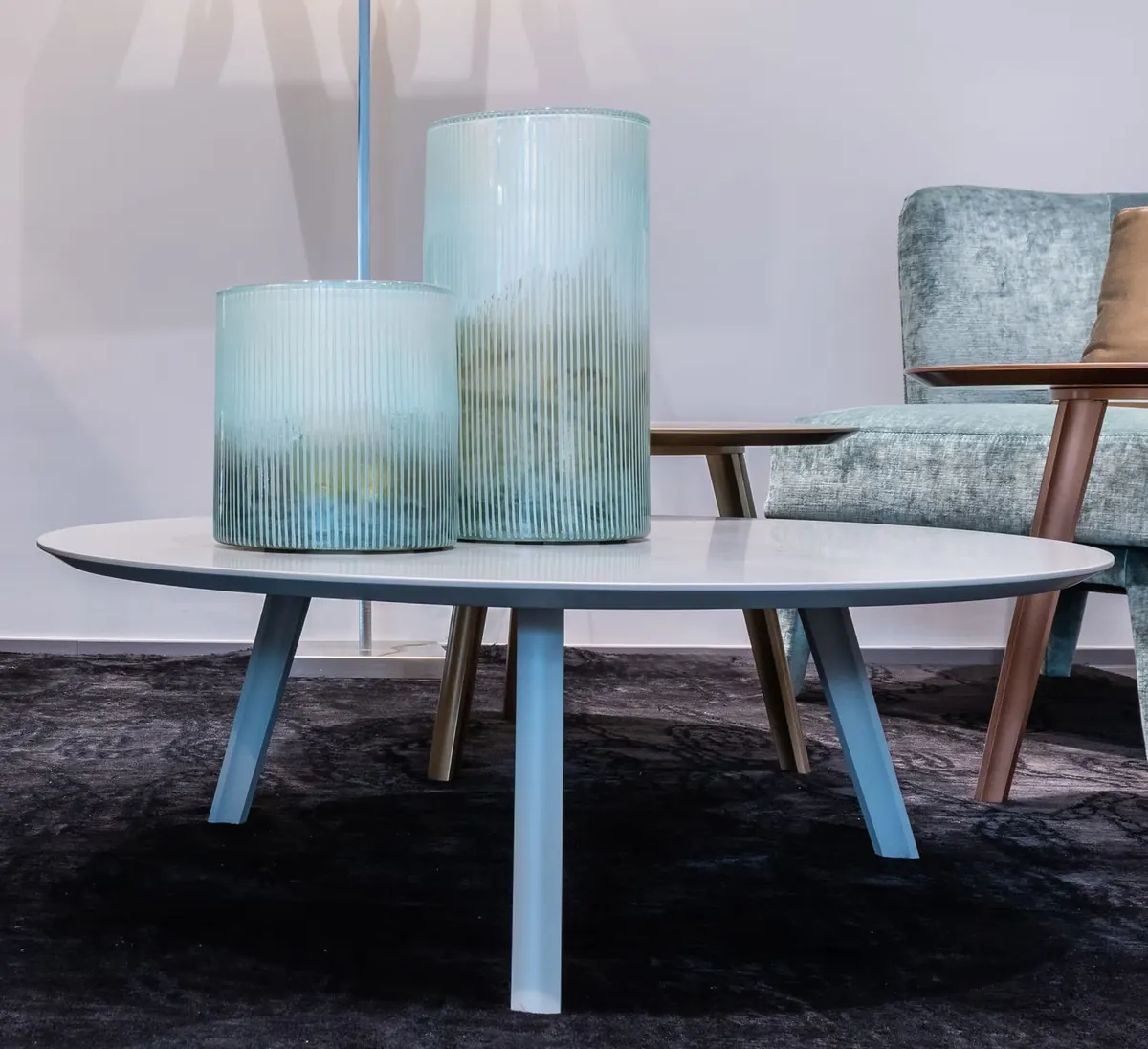
Two jobs, one small room. A coffee table has to hold your tea and stay out of your way, and in a tight living room those two aims pull against each other. Round and square tables solve that problem differently, and the better choice usually comes down to measurements rather than taste. Work through the checks below and you will avoid the two mistakes that make people regret a purchase: a table that blocks the way through, or one that leaves everyone stretching from the sofa.
Start With the Footprint, Not the Style
Before you look at a single product page, measure the gap between the front edge of your sofa and whatever faces it. A wall, a media unit, a fireplace, a radiator. Write the number down. Then subtract the space your legs and knees need.
Between 35cm and 45cm of clear floor between the sofa and the table edge is a comfortable working rule for most adults. Sitting down, standing up and reaching for a mug all happen in that gap. Squeeze it to 25cm and you will spend your evenings shuffling sideways.
Say the gap measures 1.2m. Take away 40cm for legs and you are left with roughly 80cm of depth to play with. That rules out the big square coffee table you liked online, and it tells you a 70cm or 80cm table will sit properly.
Length matters too. As a rough guide, look for a table around half to two-thirds the length of your sofa. Beside a standard three-seater, that means something in the region of 1m to 1.3m. Any longer and the table starts to feel like a barrier rather than a piece of furniture.
Match the Shape to Your Sofa Layout
Shape has to answer to the seating you already own. The sofa is the expensive piece, and the table is the one that should adapt.
Corner and L-shaped sofas
A round table is usually the easier fit in the inner angle of a corner sofa. There are no corners to collide with the chaise, no awkward gap where the straight edge of a square table meets the return of the sofa. A square table can work, but it needs the space to sit parallel to one arm, and in a small room that luxury is often missing.
Straight sofa against a wall
Here a square or rectangular table earns its place. It echoes the parallel lines of the sofa and the wall, and the arrangement reads as one tidy zone rather than a collection of objects. A rectangle in the same footprint as a round table also places more of its surface within easy reach of both ends of the sofa.
Two sofas facing each other
The gap between them is essentially a corridor. A round or oval table softens that corridor and makes the space feel less like a waiting room. If the gap is under a metre, consider an oval or a slim rectangle; a full square will chop the room in half.
Read Your Traffic Routes
Now think about how people actually move. The route from the door to the window, from the hallway to the kitchen, from the sofa to the bookshelf. In small rooms these paths often cut straight across the middle of the floor, which is exactly where a coffee table wants to live.
Tape the route out on the floor with masking tape and walk it a few times. Ask yourself whether the path runs alongside the table or diagonally past it.
- Diagonal routes suit round tables. There is no corner to catch a hip or a knee, so you can cut past the edge without thinking about it.
- Routes that hug the table lengthwise suit square tables. A square is at its widest in the middle, same as a circle, but its corners are what usually catch shins, vacuum cleaners and small children.
- A through-route in a tight room often means no fixed coffee table at all. Nesting tables or a pair of small round side tables you can pull apart will serve you better than one large piece.
One honest point in favour of round: in a cramped room, the absence of corners matters more than the difference in surface area. Your shins will notice.
Surface Area, Height and Corners
A square table of a given width gives you noticeably more usable surface than a round table of the same width, because a circle loses the four corners. Roughly speaking, a round table of 80cm across offers about a fifth less surface than an 80cm square. If the table needs to hold a laptop, a board game or a tray of drinks, that difference shows up quickly.
Height is the other easy thing to get wrong. Coffee tables generally sit between 40cm and 45cm high. Aim for a table that is level with, or slightly lower than, your sofa seat. Too low and you will be bending forward all evening; too high and it competes with the sofa instead of serving it.
Edge profile is worth a thought if the table sits on a busy route. Soft-cornered squares, rounded rectangles and oval tables borrow the safety of a circle while keeping most of the surface. If you have toddlers or a narrow walkway, that compromise is often the sensible one.
The Checklist
- Measure the gap between the sofa and whatever faces it. Write it down.
- Subtract 40cm for legs and reaching. What remains is your maximum table depth.
- Check the length: half to two-thirds of the sofa is a comfortable guide.
- Note your sofa layout. Corner sofa leans round; straight sofa leans square; facing sofas lean round, oval or narrow rectangle.
- Walk your traffic routes. Diagonal paths favour round; straight paths and defined zones favour square.
- Decide what the table is for. Cups and a book are fine on a circle; laptops and games push you towards corners.
- Tape the outline on the floor at the right height and live with it for a few days before ordering.
- Check the table height against your sofa seat, and measure your doorways if you are buying online.
Try It Before You Commit
A cardboard template is the cheapest piece of furniture you will ever own. Cut it to the size and shape you are considering, or simply tape a rectangular outline on the floor, and leave it there for a week. Walk around it, sit down opposite it, see whether it annoys you when you are carrying a plate.
If the outline still feels right after seven days, you have your answer. If you find yourself stepping over it, you have learned something useful for the price of some tape.
And if the choice genuinely feels like a coin toss, take the soft-cornered square or the oval. Both give you the surface of a square with most of the forgiveness of a circle, and in a small living room that is usually the deal worth making.
Photo: Max Vakhtbovych / Pexels