
Standing Desks vs Traditional Desks: What to Consider Before Buying
A desk is one of those purchases you make once and live with for years, which is why the standing-versus-fixed question tends to circle back. Standing desks have gone from novelty to default in a lot of offices, and the promise is appealing: move more, feel better, stop that mid-afternoon slump. But a standing desk that never rises is worse than a fixed desk you actually like. Before you spend, it's worth thinking about how you genuinely use a desk rather than how you'd like to.
Start With How You Work, Not the Desk
Spend a week noticing what you actually do at your desk. Not the version of your working day you'd put on a CV — the real one. If you're on calls for hours, a standing desk earns its keep quickly: you pace, you gesture, your voice carries better when you're upright. If your day is long stretches of concentrated writing, coding or drawing, sitting is often where the fine work happens, and a powered desk may simply stay in one position.
Think about who else uses the space, too. A desk shared by two people at different heights is one of the strongest arguments for an adjustable frame. A desk in the corner of a spare room that only you use is a much weaker one.
Cost: Where the Money Actually Goes
Fixed desks are simple objects, and simple is cheap. A plain top with four legs or two trestles costs very little, turns up constantly second-hand, and is easy to repair or repurpose. You can put the savings into a really good chair, which for most people does more for comfort than the desk itself.
Standing desks cost more for one reason: the frame. Motors, a control box, a handset and a structure stiff enough not to wobble at full height all add up. When you compare models, look past the top and ask:
- Weight capacity. Two monitors, a laptop, speakers and a printer add up faster than you think.
- Stability at maximum height. A desk that shakes while you type is a desk you'll lower and leave down.
- Warranty on the frame and motor. These are the parts that fail; the top rarely does.
- Spare parts. Can you buy a replacement handset or control box in three years' time?
If the budget is tight, a sit-stand riser or a converter that sits on a fixed desk gets you part of the way for a fraction of the cost, though you lose the freedom to change the whole surface height.
Space: The Measurement People Forget
A standing desk needs more room than its footprint suggests. It has to travel upwards, and at full height the top may sit around chest or shoulder level — which means it can meet shelving, a sloped ceiling, a window latch or a pendant light. Check the maximum height against whatever sits above the desk before you order, not after.
Two other measurements matter. First, your own standing elbow height: measure with the shoes you'd normally wear, then add a couple of centimetres. The desk's height range needs to reach that comfortably. Second, cable slack. A monitor cable that is just long enough when the desk is low will pull tight the moment you raise it, so leave loops.
Depth is worth a thought as well. Standing tends to push you slightly further from the screen, so a deeper top — and a monitor arm, if you can stretch to one — makes the standing position feel natural rather than cramped.
Comfort and Posture
At a fixed desk
If you sit, the chair is doing the heavy lifting. Look for a seat height that lets your feet rest flat, a backrest that supports the curve of your lower back, and enough adjustment that you can change position through the day. A footrest helps shorter users; a cushion behind the lower back helps taller ones. Many fixed desks can also be raised or lowered once with different legs or feet, which is a cheap way to get closer to the right height.
At a standing desk
Standing all day isn't the goal. Most people who get on well with an adjustable desk alternate — perhaps a spell standing in the morning, sitting for focused work, standing again after lunch. An anti-fatigue mat makes a genuine difference on hard floors, and supportive shoes beat bare feet on tile. If you have an existing back, hip, knee or circulation problem, speak to a GP or physiotherapist before you overhaul your setup; general advice can't account for your particular situation.
The Day-to-Day Reality of Each
Some things only become obvious after a few months of use.
- You'll move less than you imagine. The benefit isn't standing for eight hours, it's changing position more often.
- Fine work is harder standing. Precise mouse work, detailed editing and long typing sessions tend to pull you back into the chair.
- Motors are audible. If you're on calls most of the day, the whirring is noticeable to whoever is listening.
- Cables need planning. A hook, a tray or a strip of hook-and-loop tape tidies things and prevents snags.
- Fixed desks are quieter and cheaper to live with. Nothing to service, nothing to fail.
- Adjustable desks make better shared desks. Different users, different heights, one piece of furniture.
Deciding: A Short Practical Checklist
Before you buy, run through these:
- Note how many hours a day you sit versus move, and whether that changes with the seasons.
- Measure your sitting and standing elbow heights, with shoes on.
- Measure the space above the desk and the depth of the room.
- Split your budget deliberately between desk and chair — don't spend it all on the desk.
- If you buy powered, check weight capacity, stability, warranty and spare parts.
- If you're unsure, start with a riser on your current desk and see whether you actually use it.
A fixed desk, well matched to a good chair, is a perfectly good answer for plenty of people. A standing desk is worth the extra money when you'll genuinely change height through the day — because you take a lot of calls, because two people share it, or because you know a long afternoon of sitting leaves you stiff. Buy for the working day you have, and the desk will earn its place either way.
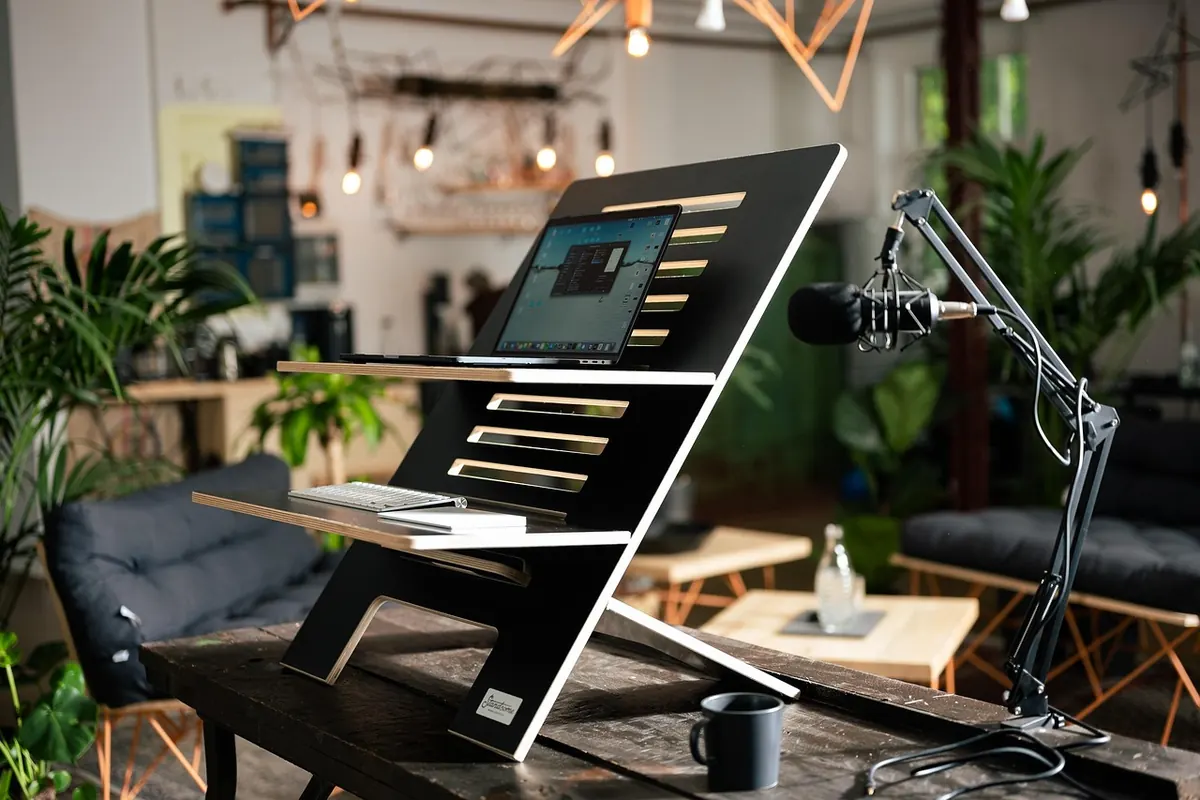
Photo: Standsome / Pixabay